


To Teach or Not to Teach: Christina’s Journey in Finding Her Place in Education
Following a student's journey to begrudgingly become an educator
Written By: Dani Espinal
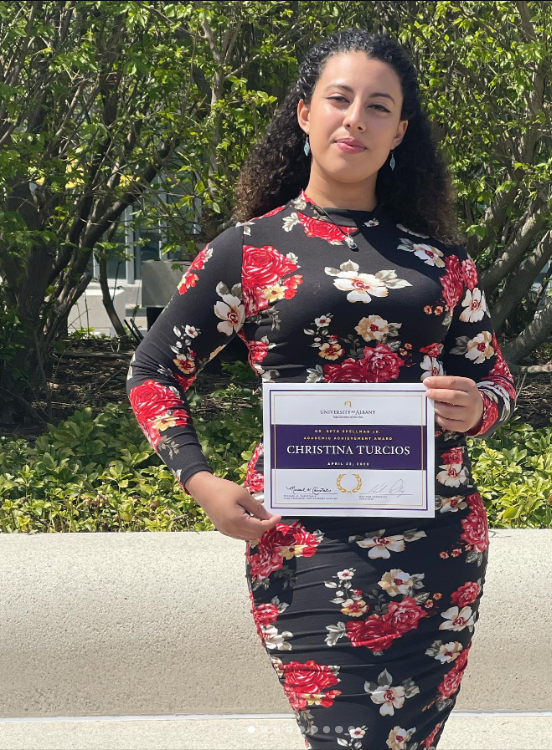
Most people can agree, figuring out what you want out of life immediately after graduation from college/university is one of the hardest things a person can do. With so many options shoved down our throats (the job fairs, the flyers, the LinkedIn/Indeed posts and oh-so many notifications), it’s a lot easier to tell yourself what you absolutely do NOT want to do.
For Ms. Christina Turcios, this was her easiest pick. About to graduate from the University at Albany with her English degree, Christina was firm in her decision: she would NOT be pursuing a career in education. Deciding on who she wants to be would be just a little easier after making her decision… right?
Growing up in Flushing, Queens and attending a strict, religious Catholic school system from an early age, Christina was always made to feel like an outsider. Facing bullying from her peers, she had to do it completely on her own as nearly every one of her teachers turned their cheeks. All before the age of 14 years old, Christina was entirely burnt out from school, with 0 faith in her ability to succeed in her education. Her teachers, the people who were supposed to serve as her guides and mentors, had completely abandoned her. In her own words, “They made me feel as if I were worthless, as if what I did didn’t matter to them. It was easier to just do nothing at all than to try.” Because of their unprofessionalism and their expectations for what Christina would become, Christina’s disdain for school and her own education grew exponentially. This caused her to withdraw, all before becoming a teenager.
Fortunately for Christina, these feelings turned on their head when she turned 14 years old and moved to Oceanside, New York. There, she was introduced to those who would be the catalyst for Christina’s passion for education.
The teachers in Oceanside High School were able to give Christina exactly what she needed. They understood her need to be seen, her want to explore different subjects and understand everything possible in her classes. It was because of these teachers that Christina was able to nurture these desires and grow. With their help, Christina was also able to pinpoint which subjects she thrived in: English and History. A complete 180 degree turn from the schools she had come from. “The constant flow of support was overwhelming at first. I didn’t really think I deserved it.” While it may have been a lot in the beginning, being seen for her accomplishments was exactly the push she needed to overcome these insecurities and rise in her education. And shine she did.
With the backing of her mentors, Christina was able to excel during the whole of her high school career. She was constantly ranking at the top of her classes and exceeding everyone’s expectations of what it means to be a hardworking student. This dedication did not come about because of a need to prove herself worthy in her new school. No, Christina dedicated all of her time and efforts into becoming a better student due to pure love for what she studied. Lucky for her, Christina was able to carry and maintain this love all throughout her college career.

In the school year, Christina remained hard at work, focused on nothing more than earning her degree. During her four years as an undergraduate, the Long Island Children’s Museum became a second home to her.
Working for the “Together to Kindergarten” program, or “TTK,” gave her a glimpse of the life of a school teacher. Every day, Christina got to spend her time working with these children and preparing them for kindergarten. Christina not only witnessed, but played a major role in getting these kids out of their shells. For many of them, this program was the children’s first time being away from their families and having to make independent decisions. This program meant everything to Christina. Working this job meant that Christina could be the teacher that she never had when she was a little girl. She could show these children the respect and appreciation that they all deserved and
made sure that each and every one of the children who came to TTK that they mattered.
Now, someone may read her story and come to the conclusion that Christina had always planned on becoming a teacher. Of course most people would believe that, assuming being a studious person and being an educator have almost always been synonymous. Combine that with her four years of experience in a classroom setting and it should have clicked that this was where Christina was meant to be.
This was not the case.
In fact, Christina was very adamant that she would not become a teacher. From the moment she decided to pursue a degree in English, she was fighting everybody’s expectations on what she would make of her life when her four years were up.
From her parents, to her grandparents. From friends and teachers, Christina was hearing it from absolutely everybody yet still persisted. Despite her seemingly natural talent, she did not want to become what she believed was the stereotypical English major.
During Christina’s final year of university, she had taken an internship at the New York State Archives. Spending her time researching, categorizing, and organizing. Boring to oh so many. The perfect job for a history buff like Christina.
However, the cards did not fall in Christina's favor post graduation. As hard as she tried, any job she applied for that fell under this category slipped right from her fingers.
Months after graduation, with the threat of student loan payments knocking on her door, Christina had haphazardly applied for a random teaching job on LinkedIn. After hours upon hours of submitting job applications for museums and libraries just to be denied or ignored, one of Christina’s first answers came from a charter school in Queens, New York. Though most other schools require their teachers to come in with a teaching certificate and a Master’s degree, this particular job required no such thing. It was as if the opportunity had fallen from the heavens in her time of need.
This transition was not something that had been easy for Christina. During the first few months, she had dealt with a serious case of Imposter Syndrome. Her time working at the Children’s Museum, while still a teaching role she dedicated years of her life to, was nothing compared to the 30+ classes of students Christina was suddenly thrown into. While the training had been plentiful and rigorous, it didn’t actually prepare her for what to do in front of a class full of middle schoolers.
Day after day, lesson after lesson, Christina found herself growing with her students. There was always something new to learn from someone new every single day. From her coworkers, Christina learned a valuable lesson that can be applied to just about any situation possible: “You’ve got to boss up. If you can’t, fake it till you make it.”

This is especially true when working with groups of children who can smell fear.
From her students, Christina learned how to stay loose. It can be so easy to lose control of the classroom if you cannot maintain the children’s attention. Therefore, Christina learned early on that remaining bold and loud in her lessons, as well as keeping loose with her movements will most certainly do the trick.
On top of that, staying passionate about the things that she teaches ensures that the majority of her students’ interest remains with her. As an English major and a history buff, Christina is almost always able to find a reference that can be tied to her lesson plan. By showing this side of herself, Christina has ensured that a bond has been built between herself and her students. “It was like something in me snapped. Like I know I’ve done this before but I just forgot until now.”
Despite still experiencing difficulties in her work, Christina has worked on it at every opportunity given to her. Any piece of advice from a peer or supervisor is taken down and internalized. Anger from dealing with attitudes from her students no longer follows her home at the end of the day. Where she once felt insecurities and doubts, she can say without a doubt now that this is where she is supposed to be. In her own words, “At first, it was like I was an outsider, invading the space. Now, I can say I have a place in it.”


Comments